'%3e%3cpath%20id='Path_8'%20data-name='Path%208'%20d='M43.014-47.522H54.352V1.339H43.014V-3.778q-6.973,6.522-15,6.522A21.61,21.61,0,0,1,11.259-4.58Q4.687-12.055,4.688-23.242q0-10.986,6.572-18.311a21.184,21.184,0,0,1,16.455-7.324q8.528,0,15.3,7.023ZM16.226-23.242q0,7.023,3.762,11.438A12.323,12.323,0,0,0,29.72-7.339a12.953,12.953,0,0,0,10.134-4.314,16.707,16.707,0,0,0,3.863-11.338,16.707,16.707,0,0,0-3.863-11.338,12.772,12.772,0,0,0-10.033-4.364,12.478,12.478,0,0,0-9.732,4.415A16.274,16.274,0,0,0,16.226-23.242Z'%20transform='translate(1267.34%20818.803)'/%3e%3cpath%20id='Path_9'%20data-name='Path%209'%20d='M65.234-67.14a6.992,6.992,0,0,1,2.157-5.117,7.049,7.049,0,0,1,5.167-2.157,7.107,7.107,0,0,1,5.217,2.157,6.943,6.943,0,0,1,2.157,5.167,7.107,7.107,0,0,1-2.157,5.217,6.943,6.943,0,0,1-5.167,2.157,7.107,7.107,0,0,1-5.217-2.157A7.166,7.166,0,0,1,65.234-67.14Z'%20transform='translate(1262.665%20881.136)'%20fill='%234973ed'/%3e%3c/g%3e%3c/svg%3e)
'%3e%3cpath%20id='Path_3'%20data-name='Path%203'%20d='M41.992-47.559H53.027V0H41.992V-4.98q-6.787,6.348-14.6,6.348A21.034,21.034,0,0,1,11.084-5.762q-6.4-7.275-6.4-18.164,0-10.693,6.4-17.822A20.619,20.619,0,0,1,27.1-48.877q8.3,0,14.893,6.836ZM15.918-23.926q0,6.836,3.662,11.133a12,12,0,0,0,9.473,4.346,12.608,12.608,0,0,0,9.863-4.2,16.262,16.262,0,0,0,3.76-11.035,16.262,16.262,0,0,0-3.76-11.035,12.431,12.431,0,0,0-9.766-4.248,12.145,12.145,0,0,0-9.473,4.3A15.84,15.84,0,0,0,15.918-23.926ZM77.881-47.559V0H66.895V-47.559Zm19.824,0,12.3,26.709,12.256-26.709h12.354L109.912,3.271,85.4-47.559Zm40.186,23.438a23.632,23.632,0,0,1,7.373-17.529,24.706,24.706,0,0,1,17.969-7.227A24.842,24.842,0,0,1,181.3-41.6a24.212,24.212,0,0,1,7.324,17.871,24.086,24.086,0,0,1-7.373,17.92,25.2,25.2,0,0,1-18.213,7.178,24.167,24.167,0,0,1-17.92-7.324A24.632,24.632,0,0,1,137.891-24.121Zm11.23.2q0,7.129,3.809,11.279a13.409,13.409,0,0,0,10.3,4.2,13.392,13.392,0,0,0,10.3-4.15q3.857-4.15,3.857-11.084t-3.857-11.084a13.409,13.409,0,0,0-10.3-4.2,13.292,13.292,0,0,0-10.205,4.2A15.281,15.281,0,0,0,149.121-23.926Zm51.123-23.633H211.23v4.248a20.979,20.979,0,0,1,5.371-4.346,12.318,12.318,0,0,1,5.664-1.221,17.744,17.744,0,0,1,9.082,2.832l-5.029,10.059a10.489,10.489,0,0,0-6.1-2.246q-8.984,0-8.984,13.574V0H200.244Z'%20transform='translate(1267.34%20738.803)'%20fill='%230D0D0D'/%3e%3cpath%20id='Path_7'%20data-name='Path%207'%20d='M65.234-67.334a6.805,6.805,0,0,1,2.1-4.98,6.861,6.861,0,0,1,5.029-2.1,6.918,6.918,0,0,1,5.078,2.1,6.758,6.758,0,0,1,2.1,5.029,6.918,6.918,0,0,1-2.1,5.078,6.758,6.758,0,0,1-5.029,2.1,6.918,6.918,0,0,1-5.078-2.1A6.975,6.975,0,0,1,65.234-67.334Z'%20transform='translate(1433.453%20799.182)'%20fill='%23FF5C1A'/%3e%3c/g%3e%3c/svg%3e)
Your Wealth Management Data Is Everywhere. Your Work Shouldn't Be.
Selvam Swaminathan, Founder·October 4, 2026
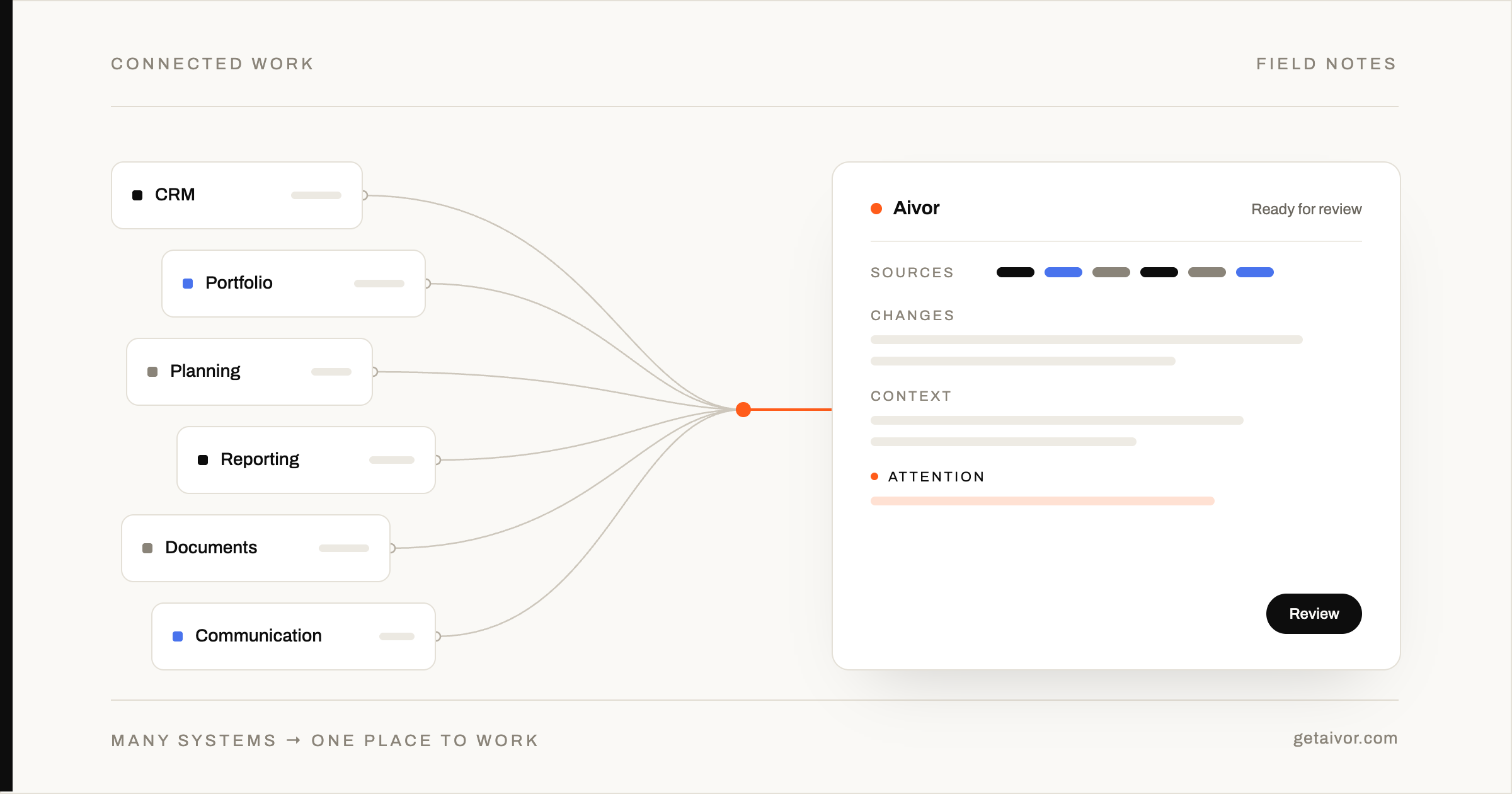
A wealth management firm can have all the information it needs about a client and still make its professionals spend hours finding it.
The portfolio is in one system. The client relationship history is in another. The financial plan lives somewhere else. Recent conversations are in email. Documents are stored in folders. Performance data comes from another platform, while account and transaction information may sit with the custodian.
The information exists. The challenge is bringing the right information together when it is actually needed.
The problem isn't a lack of data
Wealth management firms have never had more information available to them. Over the years, firms have adopted CRM platforms, portfolio management systems, financial planning software, performance and reporting tools, custodial platforms, document management systems, and communication tools. Each one serves an important purpose.
But the work that financial professionals do rarely happens inside just one of these systems.
Consider something as common as preparing for a client review. An advisor may need to look at the client's relationship history, review the portfolio and recent performance, check for allocation or concentration changes, look at the financial plan, review recent communication, check for outstanding requests, and look through relevant documents.
None of these tasks is particularly complicated on its own. The difficulty comes from having to move between multiple systems, find the relevant information, understand it, and then connect everything together.
The professional effectively becomes the integration layer between all these systems.
More technology doesn't always mean less work
This is one of the interesting contradictions in wealth management technology.
Firms have invested heavily in technology to make information easier to manage and work more efficiently. And those systems have undoubtedly made many things better. But as more systems are added, professionals can also end up spending more time moving information between them.
The problem isn't necessarily that any individual system is inefficient. The problem is that the professional's workflow crosses all of them.
A client doesn't exist as a CRM record, a portfolio, a financial plan, an account, and an email thread. It is all of those things together.
When an advisor wants to understand a client, they don't really want to "open the CRM" or "review the portfolio." They want to understand what is happening with that client and whether there is anything they need to know or act on.
That sounds simple, but getting there can require a surprising amount of manual work.
The work happens between the systems
Imagine an advisor says, "Help me prepare for my meeting with John."
That's a very natural request. The advisor doesn't want to decide which system to open first. They don't want to remember which report contains which piece of information. They don't want to manually assemble information from six different sources.
They want the work done.
To prepare properly, the system may need to look at John's client information, portfolio, recent performance, financial plan, recent communications, outstanding requests, and other relevant information. It then needs to determine what has changed, what matters, and what the advisor should pay attention to before the meeting.
Traditionally, much of that coordination has been left to the advisor or their team.
This is where AI can become genuinely useful.
AI shouldn't require another system to manage
The most interesting opportunity for AI in wealth management may not be creating another destination where financial professionals have to go to find information.
It may be reducing the amount of work required to move between the systems they already use.
Instead of asking a professional to open several applications, search for the right client, review different screens and reports, and then manually bring everything together, an AI work partner can coordinate that work across approved data sources.
The professional can start with what they are trying to accomplish rather than figuring out which tool they need.
They might say, "Prepare me for my meeting with John."
Or, "Review this client's portfolio and tell me what has changed."
Or, "Find clients whose portfolios may require attention."
The system can then determine what information is relevant, retrieve it from the appropriate sources, analyze it, and prepare the work for the professional to review.
The important part is that the professional doesn't need to think about the choreography happening behind the scenes.
From finding information to getting work done
This represents a different way of thinking about wealth management technology.
For years, much of the focus has been on helping professionals access, organize, and visualize information. The next opportunity is to help them turn that information into completed work.
Once the relevant information is connected, AI can help prepare a client meeting, analyze a portfolio, identify meaningful changes, summarize recent activity, review outstanding requests, prepare reports, or draft work for human review.
The value isn't simply having a better view of the data.
The value is reducing the work required to turn that data into something useful.
That distinction is important. Financial professionals don't need more dashboards to look at. They need help getting the work behind those dashboards done.
The advisor still makes the decision
For wealth management, there is another important consideration.
AI should not replace the professional's judgment.
An advisor should remain responsible for investment decisions, client recommendations, and other professional judgments. The role of AI is to help prepare the information and analysis that allows the professional to make those decisions more effectively.
AI can gather the information. It can organize it. It can analyze it. It can identify changes and potential areas that deserve attention. It can prepare a summary or draft.
But the professional remains in control of what happens next.
That is particularly important when working with sensitive financial and client information. The technology needs to work within the firm's approved systems, permissions, and data-access policies, rather than simply having unrestricted access to everything.
A different layer for the wealth management technology stack
The existing wealth management technology stack isn't going away, nor should it.
CRM systems will continue to manage relationships. Portfolio systems will continue to manage portfolios. Financial planning systems will continue to support planning. Custodians, reporting platforms, document systems, and communication tools will continue to play their respective roles.
The opportunity is to make those systems more useful without requiring professionals to constantly move between them.
That is where an AI work layer can fit.
Instead of replacing the systems a firm already relies on, it can work across them, bringing together the information needed for a particular task and coordinating the work required to produce an outcome.
The professional doesn't have to think about which system owns which piece of information. They can focus on what they are trying to accomplish.
The future is less about where information lives
Wealth management has spent years building systems that store information.
The next evolution is helping professionals do more with that information.
The question is no longer simply, "Where is the information?"
It is, "What can we get done with it?"
That shift—from information to work—is where AI can have a meaningful impact on the day-to-day experience of financial professionals.
Because ultimately, financial professionals don't need more places to look. They need less work between the information they already have and the work they need to get done.
That is the idea behind Aivor.
Aivor works alongside financial professionals, connecting with the systems and data they already use to help prepare, analyze, review, and get everyday client and portfolio work done faster.
Instead of asking professionals to figure out which AI tool or specialist they need, Aivor starts with the work they need to accomplish. Prepare for a client meeting. Analyze a portfolio. Review a client. Create a report. Find items requiring attention.
Aivor coordinates the work behind the scenes and produces decision-ready work for the professional to review.
Spend less time preparing the work. Spend more time acting on it.
Have a thought on this post?
Send us a note — we read every one. We don't publish public comments here, so this goes straight to our inbox, not a public thread.